
City of Derby
Academy
Curriculum
SEND
SEND: Special Educational Needs and Disabilities
At City of Derby Academy, we believe every child is important. We value the contribution that every young person can make, and we celebrate what each student can do and what they can achieve.
We know that every child is unique and learns in their own way and we aim to give every student the best chance to learn, succeed and improve their life chances. We work hard to make sure that students feel safe and supported and are fully included in the life of our school.
Our SEND team helps students who need extra support. We work to:
- Help students achieve their full potential
- Remove or reduce any barriers to learning
- Provide challenge and develop independence
- Support the all-round development of our students in preparation for a successful future.
All students with SEND are treated equally and with respect. Our team follows the school’s SEND policy to support them.
Meet the SEND Team
| SENCO | Deputy SENCO |
| Mrs A Scanlon: ascanlon@cityofderbyacademy.org | Mrs T Bates: tbates@cityofderbyacademy.org |
| SEND Administrator | SEND Teacher |
| Mrs S Cudworth: scudworth@cityofderbyacademy.org | Miss L Masi |
| Our Learning Mentors: | |
| Miss R Hanson | Miss C Matlock |
| Mrs S Johal | Mrs T Minns |
| Mr G Kwiatkowski | Miss D Oladipo |
| Miss L Wilson | Miss N Dubaic |
| Mr B Beresford | Miss S Price |
| Mrs A Chaudhury-Ajaib | Mrs K Rani |
| Miss L Whittaker | |
Our SEND Vision
Following the government’s SEND Code of Practice (2014), our goal is to make sure every child feels safe, cared for, and included. We believe every child is a learner and can succeed.
We work hard to identify young people with Special Educational needs as early as possible. This helps us plan our next steps and to provide the right support. Parents and carers can talk to us about their child’s needs and progress at parents’ evenings or by contacting a member of the SEND team.
We believe the best way to help children is to understand them well. We work closely with parents, carers, and other professionals to support each child. We actively involve our students in decisions that affect them.
Our SEND Aims
- All students, including those with SEND, will be offered a broad and balanced curriculum that is relevant to them and adapted to suit their needs.
- Lessons will be planned so that every student can take part and succeed.
- Staff will expect every student to do their best in their learning and personal growth.
- Students with SEND will be educated alongside their peers.
- If needed, students will get extra help through targeted interventions using the “assess, plan, do, review” model.
- We will always focus on the individual needs of each student.
Our SEND Goals
- The whole school will understand the needs of our students.
- We will identify the needs of students with SEND as early as possible.
- We will give the right support to overcome or reduce barriers to learning so students with SEND can access their learning.
- Staff will check how well students with SEND are doing and monitor their progress.
- We will work closely with students and their families.
- We will work with other professionals to give the best support to all students.
- We will listen to students and use their ideas to improve our SEND support
SEND Documents
Here are links to the key documents that explain how students with SEND are supported within City of Derby Academy and outside of school.
All our policies ensure that all children are treated equitably. Discrimination of any kind is dealt with seriously and reported to appropriate authority.
The SEND Code of Practice is a guide that explains how schools and other services should support children with special educational needs.
Our SEND Information Report should be read alongside the school’s SEND Policy, the Equality Policy the Accessibility Plan.
The full range of local support available for young people with SEND and their families within and outside of school can be found in the Local Offer.
Derby’s SEND Local Offer – Derby City Council
We hope that complaints about our SEND provision will be rare, however, if there should be a concern, the process outlined in the school Complaints Policy should be followed.
The Trust SEND & Equality Policy can be found on the Tapestry Learning Partnership website
SEND Provisions at City of Derby Academy
All staff at City of Derby Academy follow the CoDA Classroom Code. This ensures that all lessons use inclusive approaches that benefit all children but are essential for those with SEND.
Teaching staff use strategies, resources and adaptations to the curriculum and environment that remove barriers to learning for children and young people. Examples of these strategies include:
- the use of a dyslexic friendly font, with large, well-spaced text for ease of reading
- displays which support learning e.g. word lists
- instructions are given in small chunks
- pupil’s understanding being demonstrated in a variety of ways (not just written)
- a strong focus on the importance of positive relationships
- effective use of praise for the celebration of all achievement including effort
- The use of I do, we do, you do to promote independence
- Reasonable adjustments being made to help all young people learn (as in the examples below)
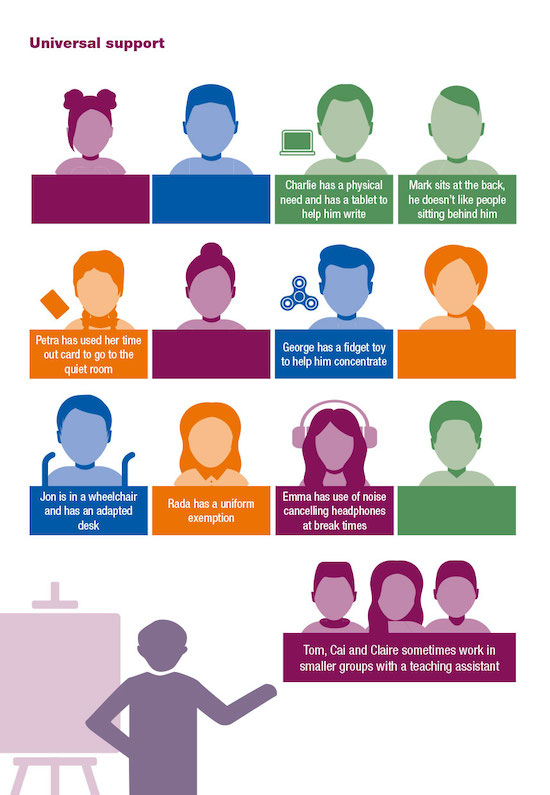
If a young person needs additional support to thrive in school, they may get extra help through targeted interventions using the “assess, plan, do, review” model. We aim to keep young people with SEND within the class as much as possible.
Support may be given in the form of a learning mentor working within the class to support the young person or a group of young people. Out of class interventions are carried out throughout the day.
If a child has complex special educational needs, we can also apply for additional funding from the Local Authority to meet the agreed outcomes on their EHCP.
Support at CoDA
Interventions Available at CoDA
Our Extended Learning Department is a space designed to support students who are identified as having SEND. Within Extended Learning we offer interventions to support students and help them to have the best chance to learn, succeed and improve their life chances. Our curriculum teams and pastoral teams also offer interventions to support learning and behavioural needs.
- Soft Start Classes – available to students in Y7 who need a gentle introduction to secondary school. These classes are taught by a reduced number of teacher within the extended learning department, supporting the development of relationships and minimising change at this important time of transition.
- Sensory Room – a calming space to help young people feel safe and regain their focus.
- Excel – a quiet working space overseen by a consistent learning mentor to provide respite for students who are finding the classroom environment overwhelming.
- Excel Plus -a named ‘safe space’, away from other students. This intervention is designed to support students who are struggling with anxiety or show other mental health concerns.
- Our Space – a supervised safe space open at break times to offer social support.
- Phonics – small group or one-to-one intervention to ensure students have the phonic knowledge they need to become successful readers.
- Reading Fluency – targeted work involving echo and choral reading to develop fluency.
- English Gateway Curriculum – an adapted English curriculum for Key Stage 3 students to help them fill gaps in their learning and become confident readers and writers.
- Nurture – a small group that meets 3 times each week to support students with their emotions, confidence and social skills.
- Lego Therapy – a structured group activity that helps young people develop social and communication skills.
- Talkabout – a programme to help students develop social skill, build friendships, understand others and feel confident in social situations.
- Therapy Dog – Boo, our school dog can support students to build relationships and develop their self confidence.

- Drawing and Talking – an intervention to support students in talking about their feelings and emotions through drawings and conversations.
- ELSA (Emotional Literacy Support Assistant) – a programme to help young people understand and manage their emotions. Our ELSA specialists are supported by Educational Psychologists.
- Active Room – students with excess energy can use our air bike if they need a movement break.
- Uniform Pass – adaptations to our school uniform for students with sensory needs.
- Accessible toilet pass
- 3-minute Leave Early Pass – to support students who find crowded places challenging. This pass allows them to move to their next lesson or break when the corridors are quiet.
- Visual timetables
- Exam Access Arrangements – this could include a reader, extra time, the use of a laptop, rest breaks or a scribe.
- Sensory Circuits – short physical activities that help students get ready for learning. They follow a sequence of alerting activities, organising activities and calming activities to improve focus and attention.
- Zones of Regulation – a tool for young people to understand and manage their emotions to help them recognise what they are feeling and identify what they can do to help themselves feel calm, focused and ready to learn.
- Soft Start – a calm and gentle way for students to start the school day. Students are given breakfast and time to settle in, feel relaxed and be ready to learn.
- Comic Strip Conversations – a visual tool to help young people understand social situations using drawings to explore what people might say, think and feel in different situations.
- Social Stories – short, simple stories to help young people understand everyday situations, routines, or events. They explain what to expect and how to behave in a clear and friendly way.
- Active Hands Fine Motor Skills – activities and strategies designed to help improve hand strength, coordination, and control.
FAQs
What are the four main areas of SEND?
If a young person has been identified as having SEND, school staff and other professionals will have worked with the young person and their families to find out which of the four areas will be their main area of need. Some young people will have additional areas of need identified.
- Communication and Interaction
This means a child may find it hard to:
- Talk with others
- Understand what people are saying
- Use language in the right way
Examples: Autism, speech and language difficulties, Developmental Language Disorder
- Cognition and Learning
This means a child may:
- Learn more slowly than others
- Find it hard to remember things
- Need help with reading, writing, or numbers
Examples: Dyslexia, learning difficulties
- Social, Emotional and Mental Health
This means a child may:
- Struggle to manage their emotions
- Feel very anxious, angry, or sad
- Find it hard to follow rules or build friendships
Examples: ADHD, anxiety, behaviour difficulties
- Sensory and/or Physical Needs
This means a child may:
- Have a disability that affects their movement or senses
- Find bright lights, loud sounds, or touch difficult
- Need special equipment or support to move around
Examples: Hearing or vision problems, physical disabilities
What can I do if I am concerned that my child may have SEND?
If you have any concerns about your child’s educational or emotional development, please do not hesitate to get in touch with our SENCO, Mrs Scanlon, or our Deputy SENCO, Mrs Bates, whose contact details are available on our main SEND web page.
What happens when my child is identified as a young person who may have Special Educational Needs?
- Initial Concerns
A teacher or staff member may notice that your child:
- Is finding learning harder than others
- Is not making expected progress
- Needs extra help with communication, behaviour, or physical needs
They will talk to you about their concerns.
- Assessing Your Child’s Needs
The school will:
- Observe your child in class
- Look at their work and progress
- Use diagnostic tests to identify your child’s needs
- Talk to you and your child
- Sometimes ask specialists (like speech therapists or educational psychologists) for advice
This helps the school understand what kind of support your child needs.
- Creating a Support Plan
If your child is identified as having SEND, the school will:
- Add your child’s name to the SEND Register. This is a list that schools keep to help track and support children who have been identified as having Special Educational Needs and Disabilities. If your child is on the SEND Register, it means that the school has recognised that your child needs extra help with learning, communication, behaviour, or physical needs and your child will receive support that is planned and reviewed regularly. It is not something negative — it’s a way to make sure your child gets the help they need to succeed.
- Create a SEND Pupil Passport. This will let all staff in school know what they should be doing to support your child to succeed in school.
- Plan what support will be given (e.g. small group work, extra time, special resources)
You will be involved in this process and asked for your views.
- Support in School
Your child may get help such as:
- Extra adult support in class
- Special teaching methods
- Time in a quiet space
- Help with speech, behaviour, or physical needs
This support is reviewed regularly to see what’s working.
- Review and Next Steps
The school will:
- Check your child’s progress
- Consult with you to talk about how things are going
- Change the support if needed
This is called the “Assess, Plan, Do, Review” cycle.
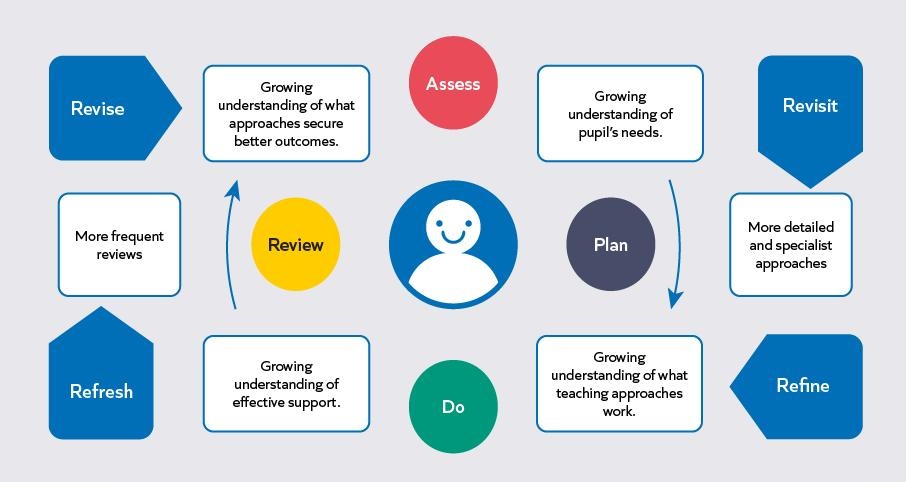
- If More Help is Needed
If your child needs more support than the school can give, the school may:
- Ask for support and guidance from specialist services such as the Derby Specialist Teaching and Psychology Services (STePS), NHS professionals or mental health support services such as CAMHS and Compass.
- Ask the local authority for an Education, Health and Care Plan (EHCP)
- This is a legal document that gives extra support and funding
You will be fully involved in this process.
 Visit our Trust website
Our Family of Schools
-

Castle View Primary School
-

Chellaston Academy
-

City of Derby Academy
-

Djanogly City Academy
-

Djanogly Northgate Academy
-

Djanogly Sherwood Academy
-

Djanogly Strelley Academy
-

Hilltop Primary Academy and Nursery
-

Kensington Junior Academy
-

Laceyfields Academy
-

Langley Mill Academy
-

Morton Primary Academy
-

QEGS Ashbourne
-

Springfield Academy
-

Springfield Junior School